You need a website, and you’ve never hired a web designer before. You’ve heard the stories: the designer who vanished halfway through, the site nobody can update without a phone call, the $400 “deal” that turned into a $4,000 lesson. Now you’re wondering how to tell the good ones from the rest.
Most of those stories are avoidable, and you don’t need to be an expert to avoid them. You just need to ask the right questions before you sign anything. I’ve built websites for small businesses for years, and this is the list I’d hand a friend.
The short version
Five things matter most. You should own your domain, your hosting, and your site. You should be able to edit the site yourself. You should know what happens after launch. Everything should be in writing. And you should trust the person you hire. The rest of this guide is how to check each one.
Before you talk to anyone
Get clear on two things: what you need the site to do, and what you can spend. “I need a website” is not a brief. “I need a five-page site so brides can see my work and request a quote” is a brief. The clearer you are, the harder it is for someone to sell you the wrong thing.
Write down your must-haves (contact form, service pages, photo gallery) and your nice-to-haves (blog, online booking, live chat). Bring that list to every conversation, and ask two or three designers the same questions so you can compare their answers side by side.
The questions that matter
Can you show me live sites you’ve built, and can I contact the owners?
Portfolio screenshots are easy to fake. Live sites you can visit are not. Open a few on your phone, click around, and see whether they load quickly and look right. A designer whose clients will vouch for them is worth more than one with a pretty Dribbble page. If they hesitate when you ask for references, that tells you something.
Who owns the website, the domain, and the hosting when we’re done?
The right answer is you. All of it. That means your name on the domain registration, your hosting account (or one you can take over), and full admin access to the site. If a designer wants to keep ownership of any of it, find a different designer. This is the most common trap I see, because it leaves you unable to move your own site. It’s also easy to avoid. Ask up front, and later you can check who a domain is registered to with a free WHOIS lookup.
What happens after launch?
A website needs updates, backups, and someone to call when something breaks. Ask what ongoing support looks like, how quickly they respond, and what it costs each month. Some designers hand you the keys and move on. That can be fine, but you should know that’s the plan before launch day, not after.
Get more of this in your inbox
I send a short, practical newsletter for small business owners. Website tips, content ideas, no guru energy.
How do I make changes myself?
You should be able to update text, swap photos, and add a page without calling anyone or touching code. Ask for a walkthrough before you make the final payment, and ask them to make one small edit while you watch. If a simple edit requires a support ticket, the site wasn’t built with you in mind.
What’s the timeline, and what do you need from me?
Many delays in web projects come from the client side (waiting on photos, copy, or feedback), and most frustration comes from nobody saying that upfront. A good designer tells you the timeline and exactly what they need from you and when.
What’s included, in writing?
Number of pages, number of revision rounds, who writes the copy, who sources the images, and what happens if you want changes beyond the scope. Get all of it in a proposal or contract. If it isn’t written down, it isn’t part of the deal.
How do you handle backups and security?
For a WordPress site, the answer should include automated off-site backups, update management, and some form of security monitoring. Ask where the backups are stored and how often they run. If the designer looks confused by the question, they probably build sites without maintaining them, which is worth knowing before you hire them.
Red flags
These are easy to spot once you know them.
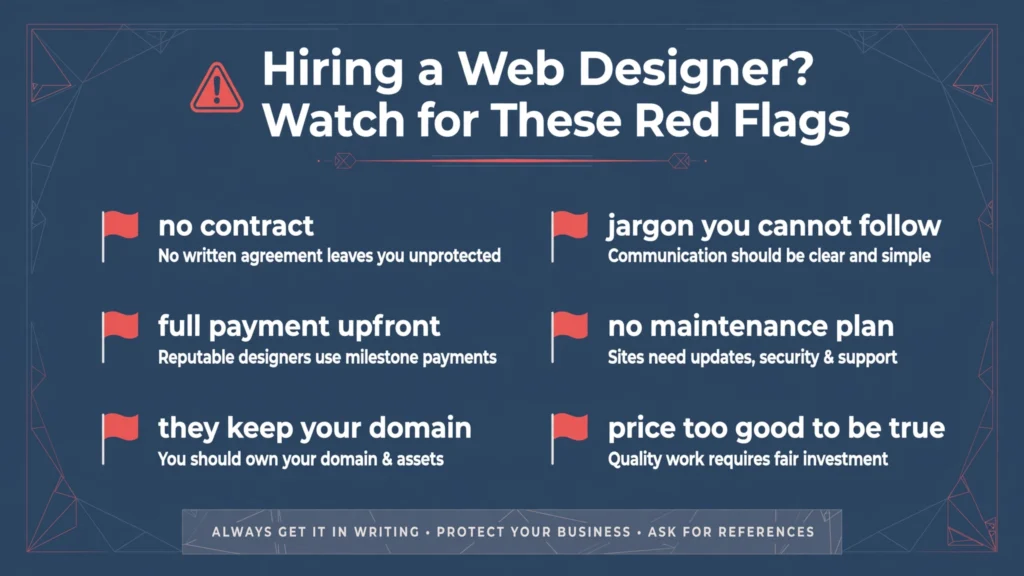
No contract or proposal. Professionals put it in writing.
Full payment upfront. A deposit (often 30 to 50%) is normal. All of it before any work starts is not.
They register your domain in their name. Your domain is your business identity. It should be registered to you.
They can’t explain things in plain English. Some jargon is unavoidable. Constant jargon makes it hard to know what you’re agreeing to, and support will likely feel the same way.
No maintenance plan and no interest in one. Either they haven’t thought about what happens after launch, or they plan to charge emergency rates when something breaks. Ask which.
The price seems too good to be true. A $500 custom website is usually a template with your logo added, or a project that stalls partway. Real work costs real money.
They’re hard to reach during the sales process. If they’re slow to respond while trying to win your business, expect the same after you’ve paid.
What a good proposal looks like
A proposal you can say yes to includes a clear description of what will be built (pages, features), who’s responsible for what (copy, images, content), a timeline with milestones, and a payment schedule tied to those milestones. It also spells out revision terms and post-launch support details. For example, the payments might be split into a deposit, a middle payment when the design is approved, and a final payment at launch. It reads like a plan, not a brochure.
If you get a one-page quote that just says “Website: $3,000,” you don’t have a proposal. You have a guess.
How pricing models compare
You’ll usually see one of three models.
Fixed price: You know the total upfront. This works best for well-defined projects. Make sure the scope is detailed, because “out of scope” is where fixed-price projects get expensive.
Hourly: This is flexible but open-ended. It’s fine for ongoing work with someone you trust. Ask for estimates and regular check-ins, not a blank check.
Monthly (design as a subscription): The upfront cost is lower, but you keep paying, and you usually don’t own the site outright. Read the fine print on what happens if you cancel.
None of these is inherently bad. The bad version is not knowing which one you agreed to.
The one question that matters most
After all of the above, ask yourself: do I trust this person?
You’re handing someone your business’s front door. The portfolio matters and the price matters, but the relationship matters most. The designer who tells you “you don’t need that feature” when they could have sold it to you is the designer you want. I’d rather talk a prospect out of work they don’t need than build something useless and cash the check. Find someone who does the same.
Want a second opinion on a proposal?
If you’re looking at a proposal right now, send it to me and I’ll tell you straight whether it’s fair. No pitch attached.
 Steve runs Side Quest Solutions in Bristol, Connecticut, where he helps small businesses turn overwhelmed websites into ones that bring in work. Every client he’s ever had came by referral, and he writes like it.
One Response