
You want to know what a website costs so you can plan a budget. What you usually get is “it depends” and “let’s hop on a call.” That’s honest, but it doesn’t help you plan anything. So here’s the straight answer, with real numbers, for a small business in Connecticut in 2026.

The short version
- – DIY (you build it): $0 to about $500 per year
- – Freelancer (someone like me): $1,500 to $7,500 for a typical small business site
- – Agency: $7,500 to $25,000+, sometimes much more
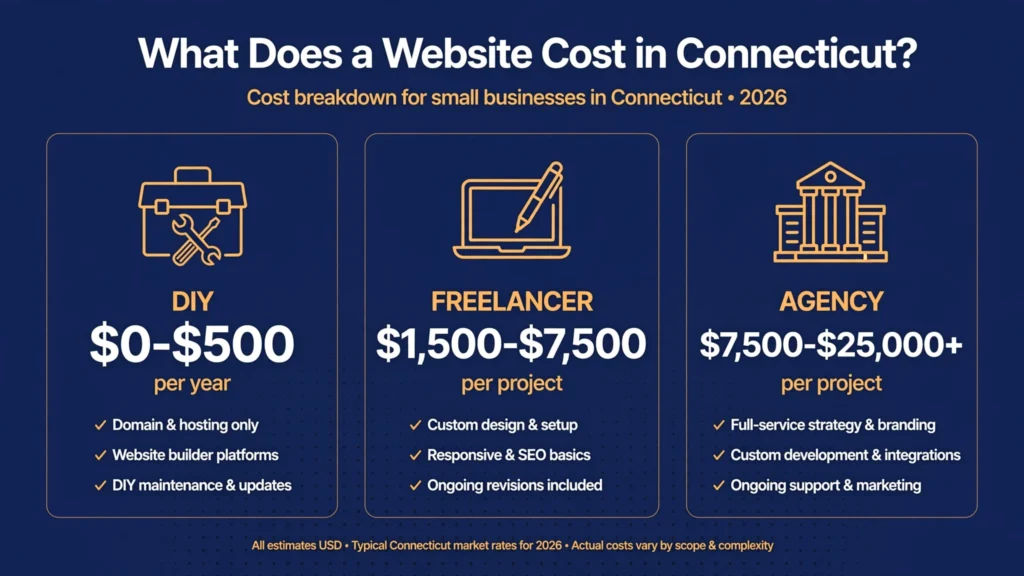
These are ballpark ranges, not quotes. They’re wide because websites are wide. A five-page brochure site and a booking-driven online store are both “websites” the way a shed and a house are both “buildings.” The rest of this post covers what moves the number.
DIY: $0 to $500 a year
This means Squarespace, Wix, or WordPress.com. You pick a template, write the words, and upload the photos. The money goes to the platform subscription (about $150 to $400 a year) and your domain name (about $15 a year).
DIY is a legitimate choice. If your needs are simple, you’re comfortable with technology, and you have more time than money, a DIY site beats no site. The trade-off is what you’d expect. It looks like a template, it says what you had time to write, and when something breaks, you’re the support department.
I’d say that even though I sell websites for a living. A DIY site you finish is better than a professional site you never get around to ordering.
Freelancer: $1,500 to $7,500
This is my world. A solo designer and developer (that’s me) builds you a custom site on WordPress or a similar platform. You get real design instead of a template, help with your copy, and a person you can call.
For most small businesses, a professional site lands in this range. A straightforward five-to-ten page site (home, about, services, testimonials, contact, a few extras) is typically $2,500 to $5,000. It goes up as the complexity goes up.
What you get is one person’s time and attention. That means personal service and lower overhead, but also one person’s schedule. Ask about timelines before you sign.
Agency: $7,500 to $25,000+
Agencies bring a team: designer, developer, copywriter, project manager, sometimes an SEO specialist. For a complex site, that’s valuable. For a ten-page brochure site, you’re paying for capacity you don’t need.
If an agency quotes you $15,000 for what sounds like a simple site, ask them to walk you through where the hours go. Sometimes there’s a good reason, like custom functionality, serious SEO, or professional copywriting. Sometimes the price reflects overhead your project doesn’t need.
Get more of this in your inbox
I send a short, practical newsletter for small business owners. Website tips, content ideas, no guru energy.
What actually drives the price
When you’re comparing quotes, these are the levers:
- – Number of pages. Ten pages cost more than five. It’s obvious, but people forget it when they keep “just adding one more.”
- – Custom design vs. template. A designer starting from a blank page costs more than one customizing a premium theme. Both can look great. Ask which you’re getting.
- – Copywriting. The words are the hardest part of most projects. If you write everything yourself, the price drops. If you want the designer to interview you and write it, that’s real work and it’s priced that way.
- – E-commerce. Selling online (real checkout, real payments, shipping logic) adds a lot to a project. Expect it to be one of the biggest line items.
- – Booking and scheduling. Online booking looks simple and isn’t. Calendar sync, reminders, deposits, and cancellation rules all take time.
- – Photography. Stock photos are cheap. A photographer for a half day is not. For businesses where trust matters (aestheticians, remodelers, therapists), real photos are usually worth it.
- – SEO. Basic on-page SEO (titles, metadata, structure) should be included in any professional build. Ongoing SEO campaigns are a separate monthly service and should be quoted separately.
The costs nobody quotes you
The build price is not the total price. Every website has ongoing costs, and I’d rather you hear them from me than find them later:
- – Domain name: about $15 a year.
- – Hosting: $25 a month for solid managed hosting. That’s what I charge my hosting clients. Cheap $5-a-month hosting exists, and it usually shows in speed and support.
- – Maintenance: WordPress sites need updates, backups, and security monitoring. My care plans run $249 a month and cover all of it. Skipping maintenance is a common way small sites run into trouble, and cleaning that up usually costs more than the maintenance would have.
- – Domain privacy, SSL, premium plugins: usually $50 to $200 a year in small pieces.
Budget roughly $500 to $3,500 a year in ongoing costs, depending on how much you hand off and how much you handle yourself.
Where my $497 tune-up fits
Not every site needs a rebuild. If your site is a few years old and basically fine but neglected, my Year-End Website Tune-Up ($497, one time) is the middle option. It covers updates, a security scan, a speed pass, a broken-link sweep, SEO quick wins, and a written roadmap for next year. It’s for sites that need attention, not replacing.
How to think about the budget
What is one new customer worth to you?
If a new client is worth $2,000 to your business and a good website brings in even a few extra clients a year, the math works. If you’re a consultant whose site exists so prospects can check you’re legitimate before a call, you need credibility, not complexity, and you should spend accordingly.
The most expensive website is the one that doesn’t work. That could be a bargain site that never brings an inquiry, or a showpiece for a business that only needed a phone number and a booking button. Price and value are different things. Spend for the job the site has to do.
If you’re weighing options, send me your website address (or your situation if you don’t have a site yet). I’ll tell you what I’d do in your shoes, including when the answer is “don’t hire me.”
 Steve runs Side Quest Solutions in Bristol, Connecticut, where he helps small businesses turn overwhelmed websites into ones that bring in work. Every client he’s ever had came by referral, and he writes like it.
5 Responses