
Someone told you to start a blog. Maybe you tried, wrote three posts, and ran out of things to say. Maybe you haven’t started because you can’t picture writing something new every week for years. Either way, you’re wondering whether it’s worth the time.
Here’s my answer. You don’t need a blog that never ends. You need five posts, each doing one specific job. Write those five well, keep them current, and you’ve covered what a blog can do for a small business. I call it the 5-post website.
Not fifty posts. Not “we’ll post weekly and see what sticks.” Five. The question isn’t how much to publish. It’s what jobs a post can do for your business. There are five of them, and here they are.

Post 1: The belief
This is the post where you say what you actually believe about your work, especially if it goes against what most people in your industry say. It’s not a hot take for attention. It’s a conviction you’ve earned by doing the job.
Mine is that your website doesn’t have a traffic problem. In my experience, most small business sites don’t need more visitors. They need to hold on to the ones they already get.
A belief post does two jobs. It attracts the right people, the ones who read it and think, “finally, someone said it.” And it filters out the wrong ones, which is just as useful. A prospect who disagrees with how you see the work will be a hard client. It’s much better to find that out from a blog post than six months into a project.
A therapist might believe that clients don’t need more coping tips, they need a better fit with the person helping them. A remodeler might believe the cheapest bid is rarely the cheapest job. Those are beliefs a reader can agree or disagree with, which is the point.
To find yours, finish this sentence: “Most people in my industry think X, but I’ve learned that Y.” If you can’t finish it, pay attention for a week to what you keep telling clients. That’s usually where it’s hiding.
Post 2: The money-keyword guide
This is the practical, search-friendly guide that answers the question your buyers type into Google right before they spend money. It’s the one with commercial intent.
Mine is a guide to what a website costs in Connecticut, with actual ranges instead of “it depends, call me.”
Yours is whatever your customers ask about price, cost, or comparison. A remodeler might write about what a kitchen remodel costs. A bookkeeper might write about when you need a bookkeeper and when you need an accountant. Whatever the question is, answer it completely and honestly. A buyer who asks about price and gets a dodge usually just clicks the next result.
This post works while you’re not. It’s there at 11pm when a prospect is researching, and it answers their question clearly. By the time they call, the money conversation has already started, so the call goes easier.
Post 3: The buyer’s guide
This post helps someone buy well, even if they don’t buy from you. It’s a guide to hiring someone in your industry without getting burned: the right questions to ask, the red flags, and what good looks like.
Mine is about how to hire a web designer without getting burned. It names the common traps, like a designer who keeps ownership of your domain, wants full payment upfront, or disappears after launch. It tells readers exactly how to protect themselves.
Good buyer’s guides tend to cover three things: what to ask before you sign, what warning signs to watch for, and what a fair price and timeline look like.
This feels backwards. Why teach people how to hire your competitors? Because some readers will use your guide to hire someone else, and that’s fine. Others will read it, realize how much work it is to vet people on their own, and call the person who wrote it. That kind of teaching is what makes people trust you before they ever call.
Your buyer’s guide should be useful enough that a reader could genuinely use it to hire someone else. That’s what makes it work.
Get more of this in your inbox
I send a short, practical newsletter for small business owners. Website tips, content ideas, no guru energy.
Post 4: The proof
This is the case study. Not a brag sheet, but a specific story: here was the situation, here’s what I did, here’s why it mattered.
Mine is about building a first website from scratch for a Connecticut med spa. It covers what having no website was costing them, what the build included, and why a site matters so much for a high-trust local business.
Keep the structure simple: the situation they were in, what you did about it, and what changed afterward. If the client is happy for you to share it, use their own words for the problem.
Your proof post doesn’t need dramatic numbers. It needs specifics. Something like “we rebuilt the booking flow and stopped losing inquiries” is more convincing than “we increased conversions 300%!!!” Small business owners want to work with someone who understands their situation, and a detailed story about a business like theirs shows that better than any claim.
One honest case study does more than a page of claims about how great you are. Show what you did and let the reader decide.
Post 5: The signature method
This is the post you’re reading. It’s where you name your way of working and teach it.
The 5-post website is my signature method. The idea is that a small set of deliberate posts beats a big pile of random ones, that five posts can answer every question a buyer asks along the way, and that most small businesses should stop blogging weekly and start blogging on purpose. This post is also my number five, so it’s the method working inside the method.
Your signature method is whatever you do differently, the approach you’d explain to a peer over coffee. Name it. Teach the basics. Let the post itself show that it works.
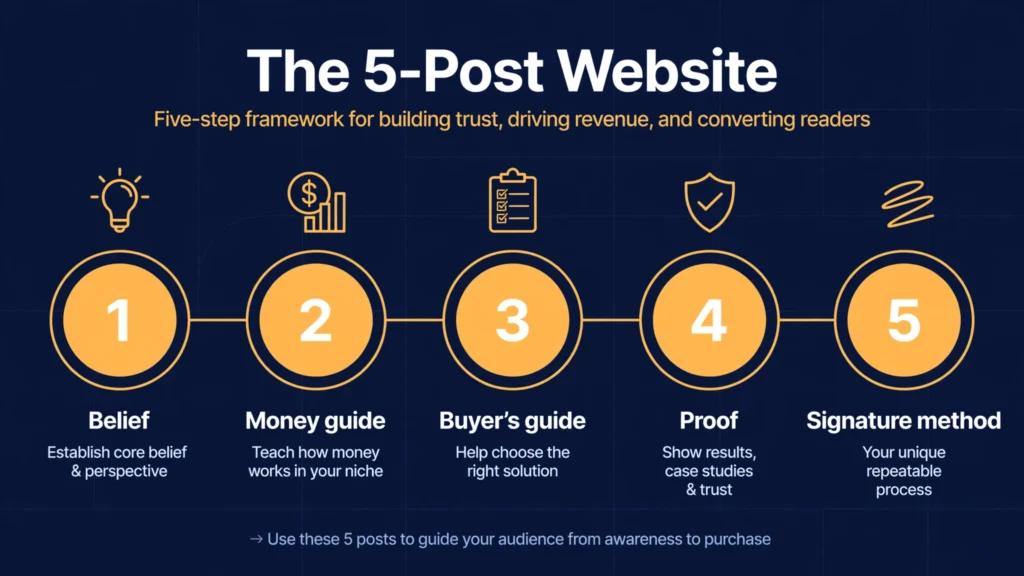
How to pick your five
Here’s the process for your own business:
- 1. Write down your belief (post 1). What do you know that your industry gets wrong?
- 2. Find your money keyword (post 2). What do buyers search right before spending?
- 3. Write the guide you’d give a friend (post 3). How should someone buy what you sell, even from a competitor?
- 4. Tell one specific story (post 4). Which client situation best shows what you do?
- 5. Name your method (post 5). What’s your way of working, and how does it work?
Write them in that order. Each one makes the next one easier. By post 5 you’ve already explained your beliefs, your market, your approach to honesty, and your results. All that’s left is to name the system.
Why five beats fifty
Plenty of business blogs stall out. A burst of posts, a long gap, then nothing, with the last entry dated a few years back. Visitors notice, and it can make a business look less active than it is.
If that’s your blog, it’s fixable. Five strong posts give visitors something solid to find. A pile of thin posts takes more upkeep and tells them less.
Keeping five posts current is a small job. Once or twice a year, read through them, fix anything that’s out of date, and add a line or two where something has changed. That’s an afternoon, not a content calendar.
Start with your five. You can always write a sixth.
If you’d like help figuring out what your five should be, send me a message and tell me what your business does. I’ll tell you what I’d write in your shoes.
 Steve runs Side Quest Solutions in Bristol, Connecticut, where he helps small businesses turn overwhelmed websites into ones that bring in work. Every client he’s ever had came by referral, and he writes like it.
One Response